A byline for the evidence
Journalism has always run on attribution — who saw it, who stands behind it. Chain of custody is the byline extended to your sources. And it forces an honest reckoning with what a faithful record actually contains.
The byline is the oldest accountability mechanism in journalism. I mean, it's a statement worth fact-checking but let's say that long before corrections and fact-checking desks, there was a name at the top of the page: someone saying, in effect, I looked into this, and I will stand behind it.
I've worked as an editor and a journalist, and let me let you in on a secret: the byline is both a credit, and a signature on a promise – an accountability mechanism.
I keep thinking about what that promise becomes when the story rests on online sources that can disappear. For thirteen years now, at Airwars, through the Digital Evidence Toolkit, and now at the Starling Lab, the same question keeps returning in different clothes: not only what did you find, but who found it, when, and can anyone but you confirm it?
Chain of custody is how the byline extends to the evidence. It carries the promise further down the chain: who captured this page, who handled it, who moved it into the investigation, and in what order. We've made that record a first-class part of evidx — not buried in a settings panel, but at the front of the work, where a byline belongs.
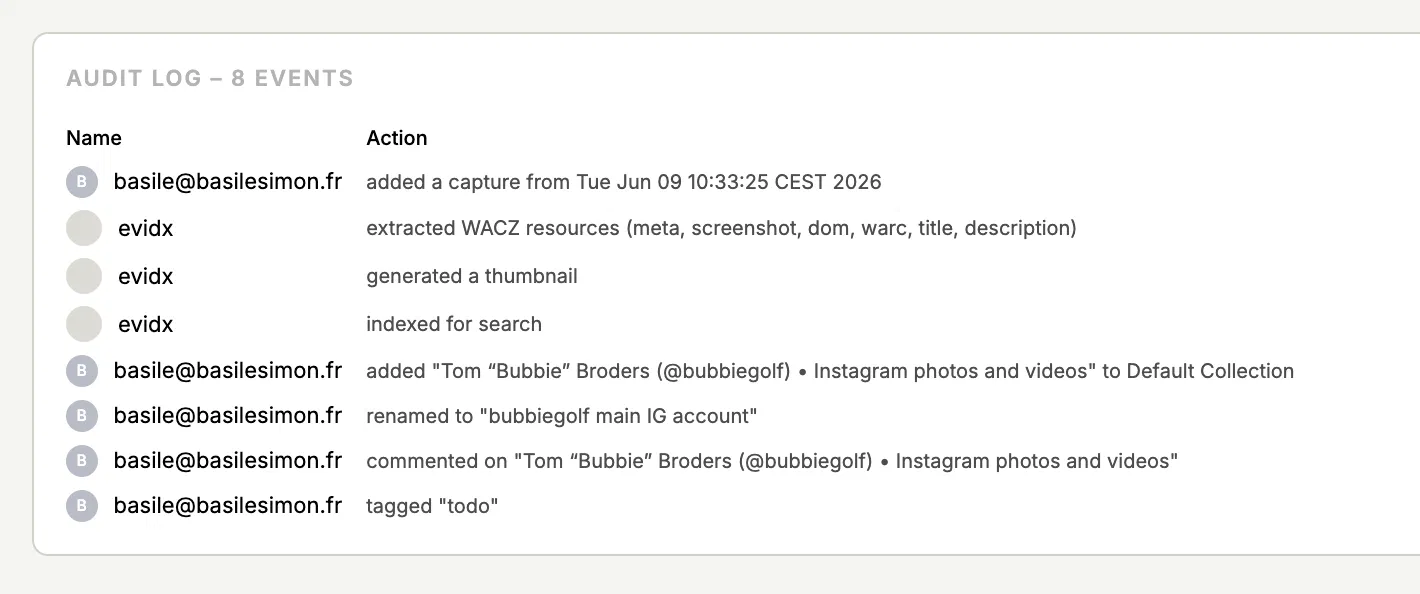
Inside a team, it looks like this: a ledger of every action, each one named, timestamped, and cryptographically signed.
It is the same point as the byline: work you can stand behind is work that is signed.
Bystanders in the captures
But here is where honesty is required, and where most tools in this space go quiet. A byline is attribution you choose: you decide to put your name to a finished piece.
A web capture is different. It preserves a great deal that nobody chose – for example the commenters under a post, their photos, and as a whole every bystander who happened to be on the page when you pressed the button. Preserve evidence faithfully and you also preserve personal data. A reporter archiving hate speech is, by definition, collecting data about people's politics, religion, identity. While it is the fidelity and this contextualisation that gives a capture its evidentiary weight is the very thing that sweeps in people who were never the subject of the story and certainly never agreed to be kept.
There are two comfortable answers to this. Both only take us so far.
The first is the journalistic exemption. European data-protection law does carve out room for journalism, and Germany's Medienprivileg is a strong protection. But it protects data processed for your own journalism — but it thins out precisely when a capsule leaves your hands: shared for legal review, handed to a court, published as an embed. It is a shield for what the newsroom holds, not a magic word.
The second is to hide behind the technology: the archive is tamper-proof, so we cannot delete anything. Regulators have answered this directly — 2025 guidance on immutable systems is blunt that technical impossibility is no excuse. If you build something that cannot forget, the duty to forget does not vanish. Which means it has to be solved in the architecture: by keeping the proof of a record separate from its readable content, so the one can be honoured without the other being destroyed.
Which brings me back to the byline, and a principle I keep returning to: you cannot outsource your conscience any more than your archive. Owning your record means owning the duty that comes with it. Not only to your readers, but to the people inside the capture who never asked to become evidence.
So the design follows from the duty, not the other way around. Captures stay on your machine by default, because owning your record means holding it close enough to answer for it. Sharing with your team, sending for legal review, publishing an embed: each is a deliberate, gated step, because each is a moment where the capsule leaves your hands and the duty travels with it. And the proof stays separate from the content, so that honouring a request to be forgotten never means destroying evidence someone, somewhere, may still need to verify.
The same record ends up with two faces. Inside the team, the full ledger: names, working states, every signed step. In public, a byline for the evidence: who captured it, who published it, the verifiable chain that proves it hasn't changed — and, importantly, not the rest.
None of this makes the hard questions disappear. A faithful record will always hold more than the story needs, and no architecture decides for you what's fair to keep. What it can do is keep that choice in your hands and keep it honest — refuse the shortcuts, surface the cost, and make sure that when you put your name to the evidence, you are standing behind all of it.
That's the byline we're after. A name at the top of the page that means what it always meant: I looked into this, and I will stand behind it — and I built something that lets me.